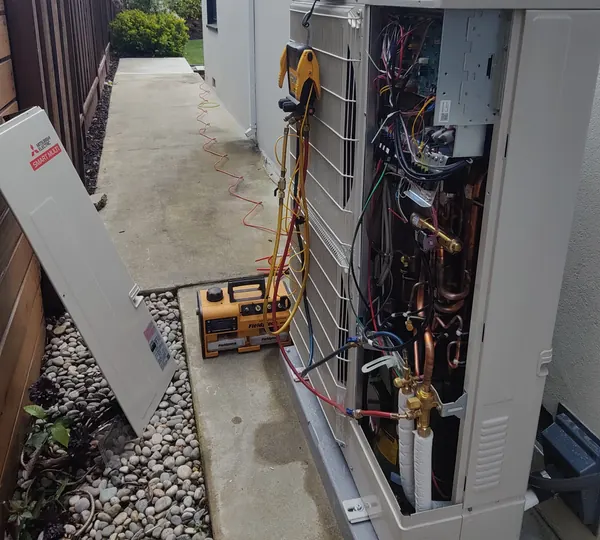
Commercial HVAC replacement on the Peninsula
Replacing a building's HVAC? Plan it first.
A commercial replacement is settled before the equipment arrives: what you have now, what the building needs, how the new unit gets in and what the city files the job under. Here is how we plan it.
What goes into planning a commercial replacement?
Swapping a unit is the short part. The planning before it decides whether the new equipment fits the building and goes in without surprises.
-
We look at what you have
The nameplate, the age, the condition, what the unit serves and what has been failing. That tells us whether this is a like-for-like swap.
-
We work out what the building needs now
How a space is used changes over the years. A unit sized for the old layout may be wrong for the current one, so the choice starts from today's use.
-
We plan how it goes in
How the new unit reaches the roof or plant area, how it meets the existing curb, pad, ductwork and power, and how long the building is without it.
-
We replace it and prove it
The new unit is started up and run through a cycle, with the readings checked, before we hand it back.
When should we replace a commercial unit instead of repairing it?
When repairs start adding up to more than the unit is worth to you. The usual signs are a failed compressor, refrigerant that keeps leaking, and one repair following another.
We start with a diagnosis, so you know what failed before anyone suggests a new unit. If a repair will do, we say so.
Does a commercial replacement need a permit?
In Burlingame, yes, it has its own permit type. The city files commercial furnace, AC, heat pump and rooftop unit replacements under Commercial Mechanical, unless the work is part of an overall tenant improvement or new construction.
Other cities have their own steps, so ask the city's building department before the equipment is ordered.
Source: City of Burlingame, Online Permitting Portal and Submittal Instructions, checked 2026-10-17
Tell us what you have now
Call and describe the unit and the building, or book a visit online.
Does the new refrigerant rule change what we can buy?
Yes. California requires new AC and VRF equipment, for homes and businesses alike, to use a refrigerant with a global warming potential (GWP) less than 750, and new VRF systems have had to meet it since January 2026.
So a new unit is not always a copy of the old one. Ask what refrigerant it uses before you agree to it.
Source: California Air Resources Board, air-conditioning equipment rules, checked 2026-10-17
Tell us what it's doing. We'll take it from there.
Call and describe the problem: the noise, the smell, the room that never warms up. Or book a visit online.