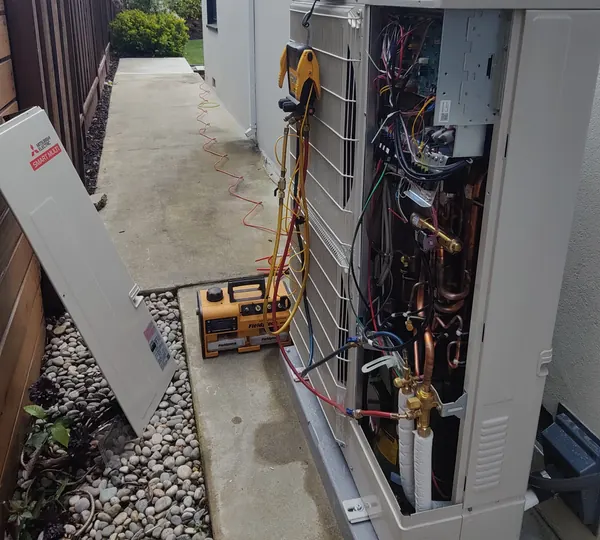
Heat pump repair in San Mateo County
Heat pump blowing cold? We'll sort it.
A heat pump that won't heat or won't cool has usually hit one of a short list of faults: a defrost cycle, a thermostat setting, low refrigerant, a stuck reversing valve or a dirty coil. We repair and maintain ducted and ductless heat pumps.
Why is my heat pump blowing cold air in heat mode?
Sometimes it's normal, for a short spell. In cold, damp weather the outdoor coil frosts over, so the heat pump runs a defrost cycle: it flips briefly into cooling mode to melt the ice, and the air at your vents can feel cool while it does. Steam rising off the outdoor unit at the same time is part of the same cycle.
If the cool air keeps going, the cause is usually one of these: the thermostat set to cool or fan only, a clogged filter or dirty indoor coil choking the airflow, low refrigerant from a leak, a reversing valve stuck in its cooling position, or a failed part in the outdoor unit. When the outdoor unit is dead, the indoor fan can keep running and push out room-temperature air, which feels cold.
Before you call, check these: the thermostat is on heat and set above the room temperature, the filter is clean, and the outdoor unit isn't buried in leaves or a solid block of ice. If those look fine, call us rather than resetting the breaker again and again.
What else goes wrong with heat pumps?
- Ice that doesn't clear. A light frost in cold weather is normal. A solid block of ice on the outdoor unit means the defrost cycle, a sensor or the airflow isn't doing its job.
- A unit that won't start. A hum with no fan or compressor movement points at a failed capacitor or contactor, both common and usually quick repairs.
- Refrigerant leaks. Low refrigerant isn't used up, it escapes, and a heat pump short of it heats and cools poorly in both directions.
- Water where it shouldn't be. A blocked condensate drain on the indoor unit, or a ductless wall unit dripping into the room.
- Short cycling and noise. A system that starts and stops constantly, rattles or squeals is wearing something out or can't move enough air.
Because a heat pump works in both seasons, a fault that hides in winter can show up in summer, and the other way round.
What a repair visit covers
A heat pump has to be tested in the mode that's failing, so the visit is built around what you're seeing, not a fixed checklist.
-
You tell us what it's doing
Cold air in heat mode, ice on the outdoor unit, a noise, a leak, a bill that jumped. When it started and what mode it was in helps us a lot.
-
We test it in heat and in cool
Electrical parts first, then refrigerant pressures and temperatures, the reversing valve, the defrost controls, the coils, the drain and the airflow through the filter and ducts or indoor units.
-
We repair the part that failed
A capacitor, a contactor, a sensor, a cleared drain, a cleaned coil, a found and fixed leak. The repair goes at the cause, not the symptom.
-
We run it and check the result
The system runs through a full cycle, with the readings checked again, before we leave.
Do you repair both ducted and ductless heat pumps?
Yes. A ducted heat pump pushes air through your ductwork from an air handler, so a repair can reach into the filter, the blower, the coils and sometimes the ducts themselves. A ductless heat pump has one or more wall or ceiling units fed by an outdoor unit, so its faults tend to show up as a leaking or noisy indoor head, a dirty coil or a lost connection to the outdoor unit.
The outdoor half and the refrigerant circuit are the same story in both, and that is where most of the serious faults sit.
What does heat pump maintenance cover?
A maintenance visit looks at what wears first: filters and ductless filters cleaned or replaced, indoor and outdoor coils checked and cleaned, the condensate drain cleared, electrical connections and capacitors tested, the defrost cycle checked, and the refrigerant readings compared with what they should be.
A heat pump never gets an off-season, because it heats in winter and cools in summer. A check once a year catches a weak capacitor, a slow drain or a slow leak while it is still a small job.
Tell us what your heat pump is doing
Call and describe it, or book a visit online.
Is it worth repairing an older heat pump?
If the fault is a part like a capacitor, a contactor, a sensor or a blocked drain, repair nearly always makes sense, whatever the age of the system.
It's worth pricing a replacement when the compressor has failed, when the system keeps losing refrigerant or when one repair follows another. Either way, we'll tell you what failed and what your choices are, and you decide.
Tell us what it's doing. We'll take it from there.
Call and describe the problem: the noise, the smell, the room that never warms up. Or book a visit online.