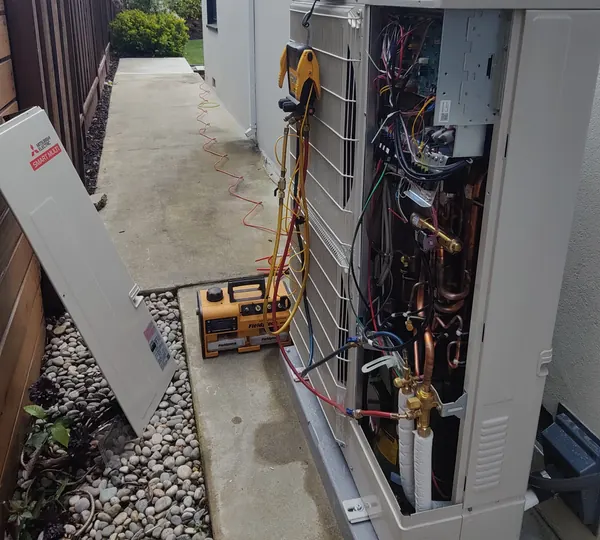
Title 24 energy rules and a system change-out
Title 24 energy rules: swapping the box is the easy part.
Replace a furnace, an air conditioner or a heat pump in California and the Energy Code comes with it: a permit, a duct test by an outside rater, and a form at the final inspection. Here's each rule, from the Energy Commission's own manual.
The test the ducts are held to
Duct leakage after a change-out
-
10 percent
of system airflow
The most the ducts may leak once the new equipment is in.
Source: California Energy Commission, 2025 Single-Family Residential Compliance Manual (June 2025), last checked 2026-10-22.
-
7 percent
leaking to outside
The other way to pass, counting only air lost outside the house.
Source: California Energy Commission, 2025 Single-Family Residential Compliance Manual (June 2025), last checked 2026-10-22.
-
6 percent
in a garage
The tighter limit when altered ducts or the air handler sit in the garage.
Source: California Energy Commission, 2025 Single-Family Residential Compliance Manual (June 2025), last checked 2026-10-22.
-
40 feet
of duct, or less
A system with less than 40 feet of duct in total skips the test.
Source: California Energy Commission, 2025 Single-Family Residential Compliance Manual (June 2025), last checked 2026-10-22.
The rules, one by one
What a change-out brings with it
Each rule is quoted from its source. The city's permit steps are in the permit guide.
On file, last checked 2026-10-22
-
California
A permit, every time
Installing a furnace, an air conditioner or a heat pump needs a building permit. Only plug-in room units are exempt.
The state licensing board warns against any contractor who offers a lower price to skip it: the permit is what gets the work inspected.
Source: California Energy Commission, 2025 Single-Family HVAC FAQ. Rules and programs change: last checked 2026-10-22.
Source: Contractors State License Board, HVAC Consumer Information Packet. Rules and programs change: last checked 2026-10-22.
-
California
The old refrigerant is recovered
Taking the old system out means recovering its refrigerant, by a technician who holds an EPA 608 Type II or Universal certificate.
Source: California Energy Commission, 2025 Single-Family HVAC FAQ. Rules and programs change: last checked 2026-10-22.
-
California
The ducts are sealed, then tested
Replace an air handler, an outdoor unit, a packaged system or a coil, and the ducts connected to it are sealed by the installer and verified by an independent ECC-Rater. Swapping only the outdoor unit, or only the indoor one, still counts.
Source: California Energy Commission, 2025 Single-Family Residential Compliance Manual (June 2025). Rules and programs change: last checked 2026-10-22.
-
California
When the test can't be passed
If neither leakage target can be met, every accessible leak is sealed and confirmed by a visual inspection and a smoke test.
Source: California Energy Commission, 2025 Single-Family Residential Compliance Manual (June 2025). Rules and programs change: last checked 2026-10-22.
-
California
When there's no duct test
The exceptions are short:
- Ducts an ECC-Rater has already sealed, tested and signed off
- Duct systems with less than 40 feet of duct in total
- Ducts that contain asbestos
Source: California Energy Commission, 2025 Single-Family Residential Compliance Manual (June 2025). Rules and programs change: last checked 2026-10-22.
-
California
Field checks, not the installer's word
Most HVAC replacements need field verification and diagnostic testing, and a new heat pump has its refrigerant charge verified in every climate zone.
Source: California Energy Commission, 2025 Single-Family HVAC FAQ. Rules and programs change: last checked 2026-10-22.
-
California
A setback thermostat
Adding or replacing any part of the system that holds refrigerant means the thermostat is upgraded to a digital setback type.
Source: California Energy Commission, 2025 Single-Family Residential Compliance Manual (June 2025). Rules and programs change: last checked 2026-10-22.
-
California
Electric resistance can't be the main heat
A replacement heating system may not use electric resistance as its primary heat source, outside the narrow exceptions the Energy Code lists.
Source: California Energy Commission, 2025 Single-Family Residential Compliance Manual (June 2025). Rules and programs change: last checked 2026-10-22.
-
California
A full replacement follows the new-system rules
Replace the air handler, the equipment and the ducts together and the job is held to the rules for a new system, starting with heating and cooling load calculations.
Source: California Energy Commission, 2025 Single-Family Residential Compliance Manual (June 2025). Rules and programs change: last checked 2026-10-22.
-
San Bruno
The energy documents, registered and digital
San Bruno asks for registered digital Title 24 energy compliance documents whenever the mechanical system is changed, so a new furnace, AC or heat pump brings them into the permit.
Source: City of San Bruno Building FAQs. Rules and programs change: last checked 2026-10-17.
-
California
The form comes at the end
For a change-out, the registered CF1R-ALT-02 document can go to the building department at final inspection instead of before the permit is issued.
Source: California Energy Commission, 2025 Single-Family Residential Compliance Manual (June 2025). Rules and programs change: last checked 2026-10-22.
Your job
Which of these land on yours?
-
Are any of the ducts, or the air handler, in the garage?
If yes
Plan for the tighter test
Altered ducts or equipment in a garage have to measure 6 percent leakage or less.
If no
The usual targets apply
10 percent of system airflow, or 7 percent to outside.
-
Is the new system a heat pump?
If yes
Its charge is checked wherever you live
That check doesn't depend on the climate zone.
If no
For an AC it depends on the zone
An air conditioner's charge check is required in some climate zones and not others.
-
Has anyone offered you a lower price without a permit?
If yes
That's the offer to walk away from
It skips the inspection the permit pays for.
How to check a contractorIf no
Ask to see the permit anyway
It should be on the job before the old equipment comes out.
Tell us what it's doing. We'll take it from there.
Call and describe the problem: the noise, the smell, the room that never warms up. Or book a visit online.