Sizing a heat pump
Bigger isn't better. Measured is.
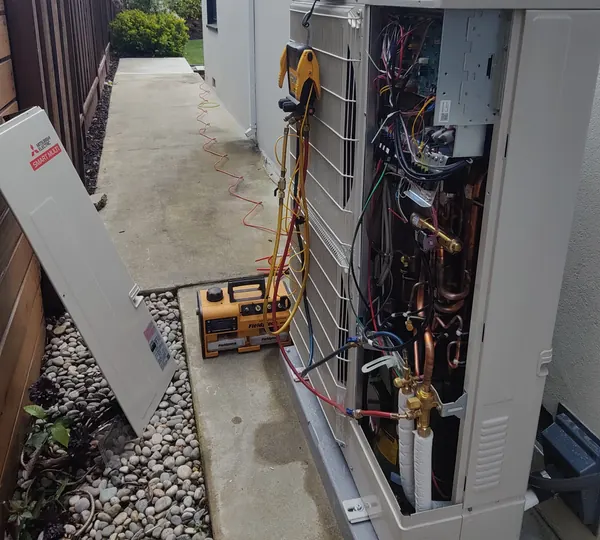
A heat pump should be sized to your house by a load calculation, not guessed from the old unit's label. California's Energy Code sets parts of that calculation itself. Here's what it fixes, and why it matters.
Why the size matters
Equipment that's the wrong size typically runs less efficiently and can make a house uncomfortable through excessive cycling and poor airflow.
That's why a proper load calculation, done to ACCA's Manual J, is required by national building codes and most state and local jurisdictions.
Source: California Energy Commission, 2025 Single-Family Residential Compliance Manual (June 2025). Rules and programs change: last checked 2026-10-22.
Source: ACCA, Manual J. Rules and programs change: last checked 2026-10-22.
What California's Energy Code fixes
The Energy Code requires the indoor design temperature for heating load calculations to be 68°F.
The outdoor design temperature can't be set colder than the city's 99.0 percent heating dry bulb or its heating winter median of extremes.
And where the older Manual S differs, the Energy Code has designers pick a system that meets the larger heating load without using backup heat.
Source: California Energy Commission, 2025 Single-Family Residential Compliance Manual (June 2025). Rules and programs change: last checked 2026-10-22.
The design lows near you
The Energy Code's design data give each weather station a heating winter median of extremes. These are stations in towns we serve.
| Station | Heating winter median of extremes |
|---|---|
| San Francisco (the table's CO station) | 38°F |
| San Mateo | 31°F |
| San Jose | 29°F |
| Fremont | 25°F |
| Gilroy | 23°F |
Source: California Energy Commission, 2025 Reference Appendices, JA2 Table 2-3 Design Day Data (CEC-400-2025-010). Rules and programs change: last checked 2026-10-22.
When bigger is allowed
The Energy Code sets no limit on a heat pump's maximum heating capacity. In a replacement or addition where airflow is field verified at 350 cfm per ton or more, there's no limit on the maximum capacity of the system at all.
ACCA's current Manual S also gives variable capacity heat pumps wider sizing tolerances, so they can be sized for heating.
Source: California Energy Commission, 2025 Single-Family Residential Compliance Manual (June 2025). Rules and programs change: last checked 2026-10-22.
Source: ACCA, Manual S. Rules and programs change: last checked 2026-10-22.
Ask to see the load calculation
It's a document, not a number on a quote. If a quote has no calculation behind it, ask for one before you compare prices.
Before you take a quote
Questions that show whether it was sized
-
Does the heat pump have electric backup heat?
If yes
It has a cap
The backup heater can't be larger than the heat pump's nominal cooling capacity times 2.7 kW per ton, rounded up.
Heat pumps in a cold snapIf no
Then the heat pump carries the load
Which is what the Energy Code sizes it to do.
-
Is it a variable capacity heat pump?
If yes
It can be sized for heating
That's exactly what the wider Manual S tolerances are for.
If no
Ask how it handles the cooling side
Sized to the larger heating load, a fixed-capacity unit can carry more cooling than the house needs, and the Energy Code accepts that.
-
Is the airflow being verified?
If yes
Then capacity isn't capped
At the verified airflow, the system's size isn't limited.
Ductwork and airflowIf no
Ask about the ducts
Airflow is what the larger sizes depend on, so ask whether your ducts can deliver it.
Tell us what it's doing. We'll take it from there.
Call and describe the problem: the noise, the smell, the room that never warms up. Or book a visit online.